

- This event has passed.
Closing the Loop: Using Comp Vision to Auto PCB E-Waste Sorting (Student Proj)
**TALK LOGISTICS:**
Monday, May 18, 2026
(remote speaker, audience can be either in person or remote on Zoom. Please RSVP and indicate if you will be local or remote)
6:30 registration, food sponsored by Neo4j, networking.
7:00 SFbayACM upcoming events, introduce the speaker
7:10 to 8:15 or 8:30 based on Q and A – presentation
Zoom link:
(updated 2 days before the event)
YouTube:
(updated 2 days before the event)
SFbayACM will support a local audience at VRP in Mountain View
.
**TALK DESCRIPTION:**
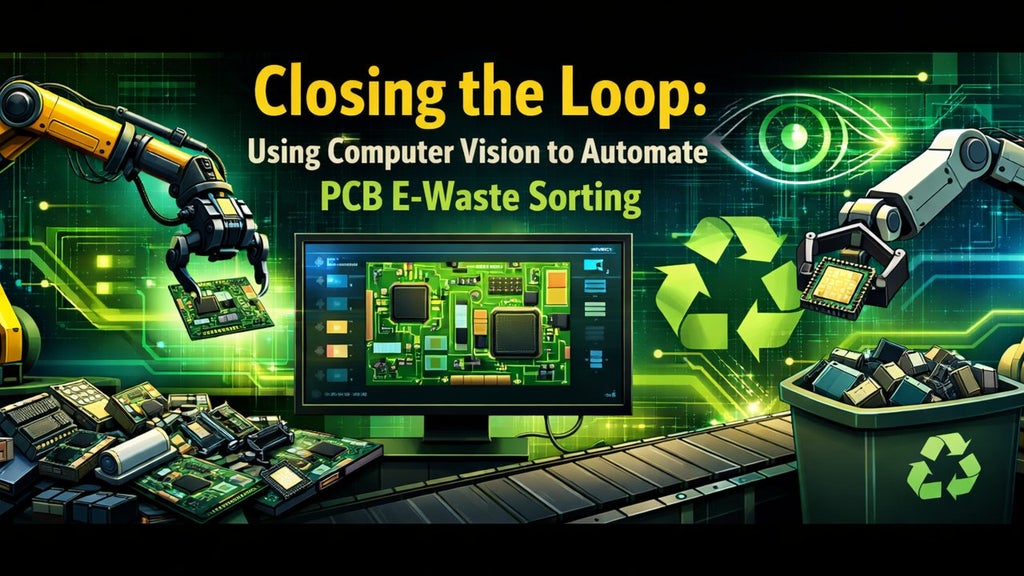
Electronic waste is one of the fastest-growing waste streams in the world, yet most recycling processes destroy valuable components through industrial shredding. This talk walks through our project building a low-cost, AI-powered system that identifies and physically sorts reusable components from discarded printed circuit boards (PCBs) — recovering more value at the component level rather than treating boards as bulk scrap.
A key advantage of our system is cost. Our full build came in at roughly $350, compared to approximately $5,000–$6,000 for a tumbler-based solution — which only recovers lower-value bulk material — and $20,000+ for a commercial pick-and-place system.
**Proposed Talk Structure:**
**1. The Problem** — Scale of PCB e-waste globally and in the Bay Area, why industrial shredding leaves recoverable value on the table, and the circular economy opportunity at the component level.
**2. Technical Approach** — Dataset construction: merging FPIC and Dataset Ninja (~6,000+ annotated images, 18 component classes). Model selection: YOLOv11 instance segmentation and why it fits a centroid-based picking system. Training pipeline challenges — class mapping inconsistencies across merged datasets. Results: ~91% mAP across component classes.
**3. Mechanical Design** — Gantry hardware selection and why a repurposed CR10 3D printer frame made sense. Stepper motor control and coordinate mapping from vision output to physical space. Tradeoffs in the mechanical design — precision vs. cost vs. complexity.
**4. The Physical System in Action** — Integrating vision model output with the gantry. Video walkthrough of end-to-end component sorting.
**5. Lessons Learned & Broader Implications** — What broke, what surprised us, and what we’d do differently. Potential applications — PCB recyclers, repair shops, maker spaces. Where AI fits in sustainable hardware reuse pipelines.
.
**SPEAKER’s BIO:**
**Vighnesh is a junior at Archbishop Mitty High School in San Jose,** California. He recently competed in his first science fair, the Synopsys Silicon Valley Science & Technology Championship, where he and his teammates placed 2nd in the engineering category. His interests span computer vision, robotics, and AI, and he has experience as a junior developer working with TypeScript, React, and SQL. He is also a member of his school’s FRC robotics team.
**Lalit is a junior at Archbishop Mitty High School** specializing in computer vision, robotics, and embedded systems, with hands-on experience spanning Arduino and Raspberry Pi integration, YOLOv11-based object detection, and competitive robotics programming in C++. He serves as the lead programmer for his school’s VEX Robotics team and co-president of the Data Science Club, where he has developed expertise in autonomous systems and real-time control. Along with Vighnesh and Vrishank, he competed in his first science fair, the Synopsys Silicon Valley Science & Technology Championship, where they placed 2nd in the engineering category.
**Vrishank is a junior at Archbishop Mitty High School in San Jose,** California. He conducted research at UC Santa Cruz’s COSMOS program in photonics, working on SPR biosensing and Fresnel lens optimization for solar sails. He competed at the Synopsys Silicon Valley Science & Technology Championship, where his team placed 2nd in the engineering category with an automated e-waste sorting system. He developed a CAR-T cell therapy manufacturing QC system for the BioHESC bioengineering competition, where his team placed 1st. His other projects include high voltage electronics such as nixie tube clocks and flyback transformer circuits. His interests are in electrical engineering, photonics, and semiconductors, and he has experience in FRC and FLL robotics.