

- This event has passed.
System Engineering: The Role of AI and Software in Emissions Reduction
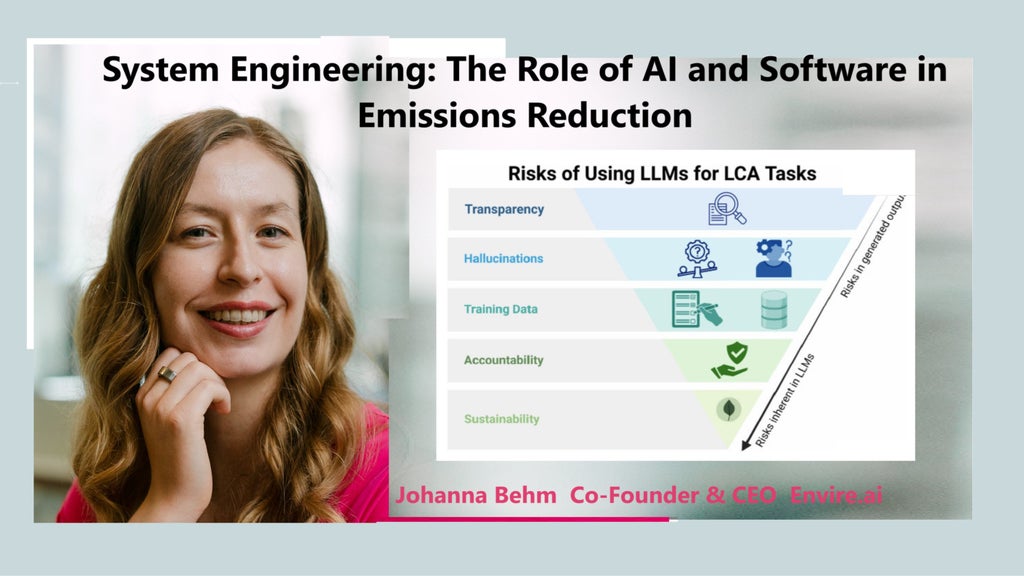
System Engineering Our Way to a Sustainable Future: The Role of AI and Software in Emissions Reduction
LOCATION ADDRESS (Hybrid, in person or by zoom, you choose)
Valley Research Park
319 North Bernardo Avenue
Mountain View, CA CA 93043
Don’t use the front door. When facing the front door, turn right along the front of the building. Turn left around the building corner. The 2nd door should be open and have a banner and event registration.
If you want to join remotely, you can submit questions via Zoom Q&A. The zoom link:
[https://acm-org.zoom.us/j/95226212956?pwd=HnAedzSDGcYAYsCzTuavIvMYMFtILa.1](https://acm-org.zoom.us/j/95226212956?pwd=HnAedzSDGcYAYsCzTuavIvMYMFtILa.1)
Join via YouTube:
[https://youtube.com/live/cu5TDl8N2Mk](https://youtube.com/live/cu5TDl8N2Mk)
AGENDA
6:30 Door opens, food and networking (we invite honor system contributions)
**7:00** SFBayACM upcoming events, introduce the speaker
7:15 speaker presentation starts
8:15 – 8:30 finish, depending on Q&A
Join SF Bay ACM Chapter for an insightful discussion on:
**Talk Description**:
Tackling climate change isn’t just a moral imperative—it’s an optimization problem. Life Cycle Assessment (LCA), the gold standard for measuring environmental impact, has historically been slow, expensive, and data-starved. But AI can change that. By automating data collection, predicting missing inputs, and scaling complex calculations, “life cycle LLMs” can make LCA fast, accurate, and actionable. With better system-level visibility, organizations can identify emission hotspots, avoid false trade-offs, and make decisions that genuinely move the needle on net-zero goals.
Software itself is part of the problem, but also a powerful lever. As computing’s carbon footprint grows, developers can embed sustainability into their work through efficient algorithms, leaner data flows, and low-carbon infrastructure choices—what some call “green coding.” More importantly, software can multiply impact: powering smart grids, optimizing logistics, or modeling entire supply chains. This talk makes the case that the biggest climate wins won’t come from treating sustainability as charity—they’ll come from treating it like the ultimate systems engineering challenge.
**Speaker Bio**:
Johanna Behm is a “recovering” event planner on a mission to help the events industry cut up to 10% of global carbon emissions by automating sustainability tracking and operational workflows for live events.
A native of Finland, Johanna grew up in a culture where sorting household waste into seven bins and minimizing waste was simply part of daily “workfow”. She was astonished by her industry’s wasteful nature and realized majority of sustainability-related problems can be attributed to poor planning and information gaps. While recruiting technical talent for her startup Envire, Johanna also realized that most software engineers are not aware that their skills could be deployed to solve some of the most pressing environmental issues and social challenges our whole planet and humanity is facing today.Prior to his work at Google, Saurabh gained valuable experience as an SRE at Okta. He is also a thought leader in SRE and cloud technologies, a mentor for startup entrepreneurs through the Google for Startups program, and a frequent speaker on the topic of foundational thinking for scalable and reliable system infrastructure.
**[envire.ai](http://envire.ai/)**
—
Valley Research Park is a coworking research campus of 104,000 square feet hosting 60+ life science and technology companies. VRP has over 100 dry labs, wet labs, and high power labs sized from 125-15,000 square feet. VRP manages all of the traditional office elements: break rooms, conference rooms, outdoor dining spaces, and recreational spaces.
As a plug-and-play lab space, once companies have secured their next milestone and are ready to expand, VRP has 100+ labs ready to expand into.
https://www.valleyresearchpark.com/